
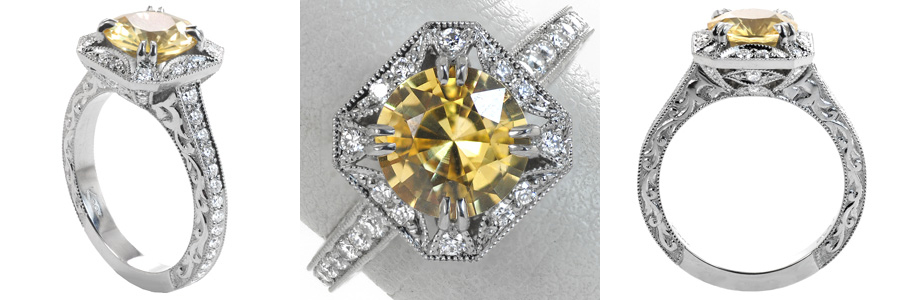
Unique Engagement Ring Styles - Filigree

What exactly is filigree?

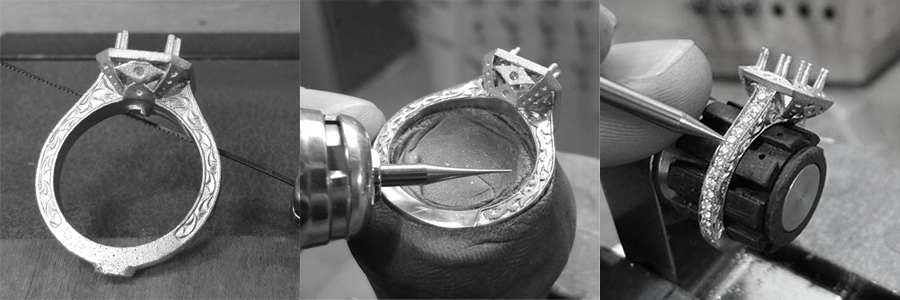
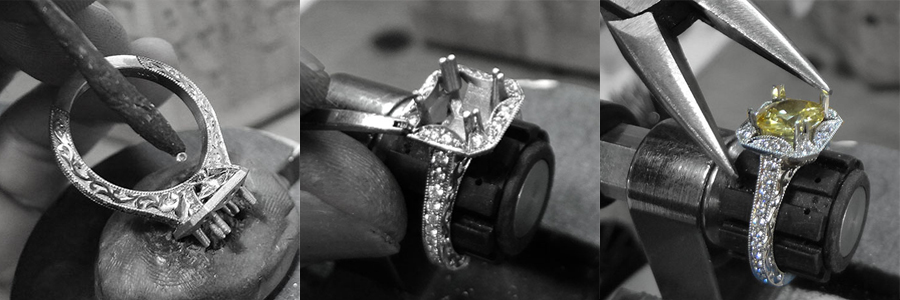
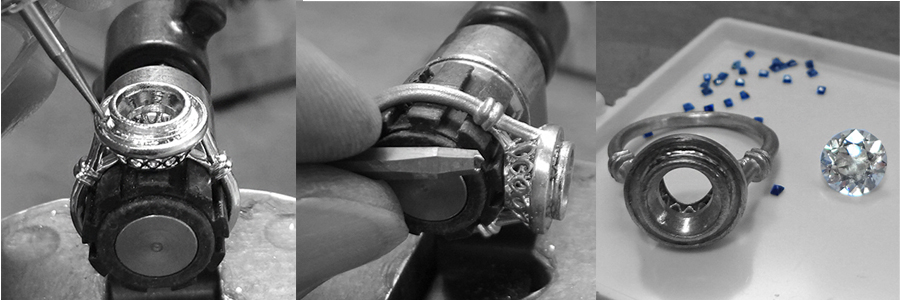
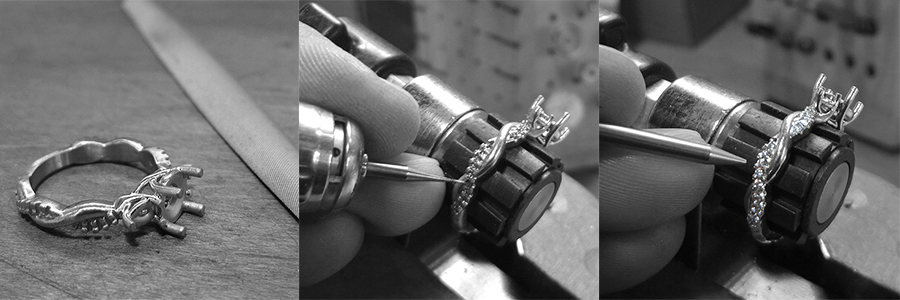
Filigree is fine and delicate ornamental work done in platinum or gold wire.

Classic Filigree Engagement Ring

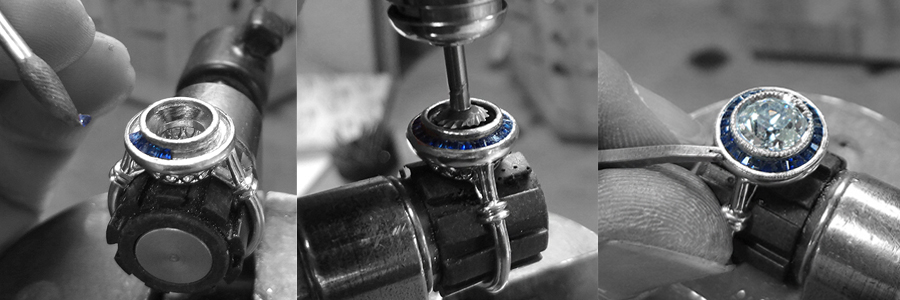
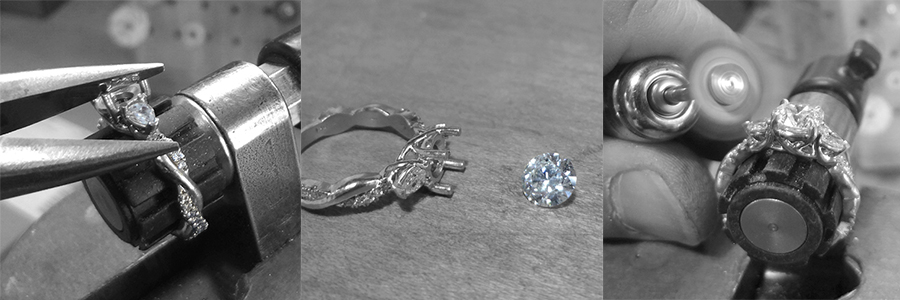
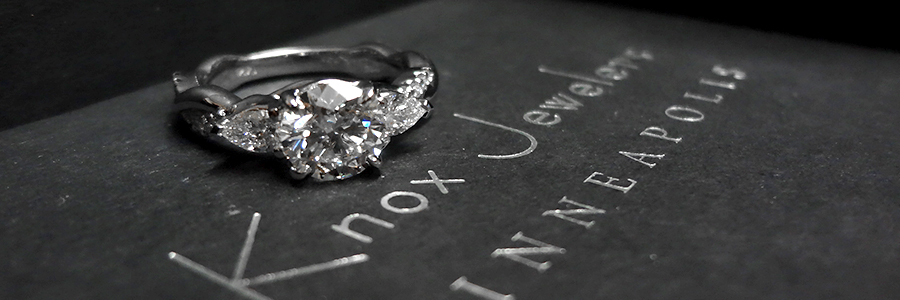
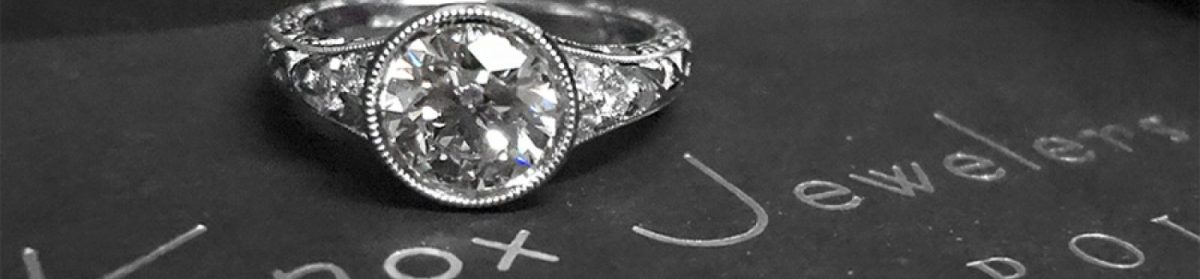
Filigree can be located on the shank or crown portion of the ring.  It can be used as a main, accent, or complementary design element.   By definition, filigree is wire work done by hand.  While it’s very common to see mass produced pieces with cast in place filigree, only true hand wrought wire can be considered as such.  Hand curled filigree is an extremely skilled and tedious task as the wire used is often under half of a millimeter or the thickness of 3-4 pieces of paper.  It takes a steady hand in welding wire to a ring and is often done under a 10X microscope to ensure proper contact and alignment.

Filigree Engagement Ring

The design pictured above uses filigree to hold several very light blue ceylon sapphires.

Can a diamond become discolored from well water?

I see and hear of this occasionally, it even happened to me once when we cleaned a 1.00 ct F color Princess cut with the last few rusty bursts of dirty steam from an aging steam cleaner.

The F color diamond suddenly looked like a J/K color with no obvious dirt or minerals showing on the diamond.

My theory is that the iron (rust) has an affinity for the diamond and sticks to the surface and/or in the hollowed out area of the prongs that are designed to protect the corner of the princess cut diamond. With even a trace of dirt or minerals contacting the princess cut diamond, the diamond will look noticeably tinted.

Here is what I do to remedy this problem, I use alternating baths in a pickle solution (heated acid bath) and heated ultrasonic along with a steam cleaner to help steam out any particles etc. This process takes patience, as it takes much more time and repeated cycles of the process than an ordinary cleaning.

As a home solution, you could maybe try some more soaking in vinegar or even a CLR (calcium,lime rust) type cleaner as long as it does not have any chlorine in it (bad for gold)

Custom making a wide Eternity Band.

The following is a little look behind the scenes in how a custom ring is made.
I will start by showing just a couple pics of the finished ring and then explain how the ring is made and show some of the steps in the process.

Here are two pics of the finished ring:

Finished custom micro pave eternity band

Finished custom micro pave eternity band

Now I will show and explain in a very condensed manner the process of making a ring like this.

Here is the ’screenshot’ from our 3-D design software showing the design from several different angles. A design like this can take many hours of design and engineering time.

Screen shot from Knox Jewelers 3D design software

After using a CAM technology to make a physical prototype and mold of the two separate elements used to make this ring, the three parts of the design are cast in 18 karat white gold. Here are a few pics of the raw castings:

We casted the design in three sections, the two outside rails and the inside pattern.

The overall finished width will be 15mm. Finger size 5.25

Raw castings of the three ring sections

Raw castings of the three ring sections

Raw castings of the three ring sections

After cleaning up the raw castings ( removing sprues, smoothing, etc) the three sections are joined.

First we tacked the three sections together in a few different spots with a laser to hold the sections together, then we hard soldered them together with a torch to assure a very durable ring.

Here are a couple pics after we finished setting the diamonds in the two outside rails.

Assembled ring with diamonds set in the rails

Assembled ring with diamonds set in the rails

Here are a couple quick pics with the rest of the diamonds set.

Assembled ring with diamonds set in the rails and center section

Assembled ring with diamonds set in the rails and center section


There is No Short Cut to Quality

The work necessary to obtain an immaculate look on a design with this level of detail is a very time consuming task and as we are fond of saying at Knox Jewelers, “there is no shortcut to quality”.

A master level artisan must carefully bright cut and engrave all of the beautiful detail into the areas around the diamonds and finally apply the mil grain which gives the design a beautiful and finished look.

The diamond setting, engraving and mil-graining labor (not counting design work, prototyping, casting) for a ring with this level of detail will have approx 32 man hours of labor when finished.

We think of projects like this as a little work of art with our name on it.

Click Here to See Video of Finished Ring

Platinum – The Ideal Metal

When customers ask what our metal of choice is for their engagement ring, they will always be told “Platinum.”  Platinum has many desirable attributes that will make your ring look spectacular and last a life time

For reference sake, we use 950 Platinum Ruthenium, which has the best combination of tensile strength (durability) and scratch resistance compared to other Platinum alloys.

Platinum is hands down the best metal to use in jewelry. It’s a very heavy, dense metal, providing a strong hold on stones and solid structural integrity. Platinum does not wear down like other precious metals. When scratched, the metal is actually displaced and pushed elsewhere on the ring, not rubbed or worn off. This characteristic puts Platinum in a class of it’s own, making it suitable for everyday wear over a life-time and maintaining the greatest security for your gemstones.

Platinum is and will always be white. It will never yellow like white gold, which requires Rhodium plating. It will never tarnish like silver either. Platinum’s natural white color is ideal for settings, from colorless diamonds to vibrant gemstones.

Platinum is also hypoallergenic unlike common white gold alloys which contain nickel. Imagine your finance not being able to wear her ring because she’s allergic to it.

Platinum does not react with Chlorine, unlike white gold, which will corrode and discolor. Chlorine is found in pools, hot tubs, and common house cleaning chemicals.

When making a decision on the right ring, make sure you understand what it’s made of. We want your setting to last a lifetime, protecting the valuable gemstones it holds. No metal does this better then Platinum. With Platinum, you don’t have to worry about allergic reactions, chemical breakdowns, or yellowing color. Make Platinum your metal of choice for life.

All About White Gold.

What is White Gold?
How is White Gold Made?
What is The Best White Gold?
What is White Gold Alloyed With?
Are All White Golds the Same?

First, an explanation of white gold and gold alloying. 14K gold is alloyed with other metals to achieve certain colors and/or workability attributes (malleability, ductility, etc.).

The different colors are self explanatory E.g.; whiter alloys such as silver or nickel mask the natural yellow of pure gold. Workability characteristics will vary considerably depending on the mix of the alloy metals. Pure gold is very malleable and easily worked into various shapes, forms, wires, etc. However, pure gold (24K) is generally considered too soft for rings. Almost all yellow gold blends are much more workable and ductile than their white gold counterparts. Most white golds are alloyed with nickel, a very white and very hard metal.

The ideal workability attributes necessary for a hand wrought item will often require a different mix of alloy metals than the normal mix of alloys for a cast item. Some of the popular alloy metals for white gold are copper, silver, zinc, nickel and in some of the newer blends, Palladium.

The white Gold blends that are alloyed with palladium are growing in popularity as they provide very workable castings and at the same time avoid many of the negatives issues associated with Nickel alloy mixes. It should be noted that these Palladium white Gold blends are typically not as bright white as some of the high nickel content blends.

14K white gold is 58% pure gold. The other 42% of metals used to make the 14K white gold and help mask the yellow of the predominant metal (58% pure gold) will vary considerably as the various gold manufacturers and casters look to develop gold blends with the best mix of whiteness and wear attributes. The same holds true for 18k White Gold, which is 75% pure gold.

Refiners, manufacturers, and jewelers experiment to find the optimal mix of alloys for their applications.Historically, some of the whiter blends of white gold have been some of the poorer performing alloys with regard to durability and longevity of jewelry items. The problems stem from the difficulty of mixing the different alloys to combine and make a homogeneous blend of metals that will be workable, malleable and otherwise suitable for jewelry making.

This is an immensely complicated issue as any change in casting temperatures or any change in the complex casting process can have an effect on the malleability, workability of the cast metal. It is quite common to have casting problems in white gold that may lead to future problems with the item of jewelry, two of the big problems are:

(1)Porosity in the metal. Actual voids or unfilled areas in the casting that lead to weakness or even failure of the cast item.

(2)Brittleness or lack of ductility.

Nickel has been a very popular alloy metal to use for white gold because of the very white color and the hardness it gives the white gold alloy. However, many white gold alloyed with nickel are not optimal for smaller elements of jewelry designs such as crowns (the prong elements that are used to hold diamonds) as these smaller elements may be prone to weakening and eventual breakdown due to the corrosive behavior of nickel in these white gold alloys, especially in conjunction with any exposure to environments that have chlorine such as pools, spas, etc.

It should be mentioned that nickel is also associated with allergic reactions which is not a good thing to have happen with an engagement ring or wedding band.

There have been many recent advances in new white gold alloys from� the major precious metal refiners that service the jewelry manufacturing industry, all trying to find that magic mix that will remedy the above mentioned problems in many white gold mixes and provide a workable and white mix.

Stuller Settings, a major manufacturer and supplier to jewelry stores : http://www.stuller.com/apps/images/kbpdfs/x1.pdf has a new blend of white gold called X-1 that is very white. Other refiners and manufacturers are also coming out with versions.

Bottom line, if you are considering a white gold jewelry item, be sure your jeweler is aware of the many recent advancements and products available. If your jeweler is aware of these choices they should also be able to recommend the optimal blend for the application as there may be design specific issues that could affect the choice.

How often will my white gold ring need to be rhodium plated?

What is Rhodium plating?
Does white gold discolor or turn yellow over time?
Are all white gold rings Rhodium plated?
How much does it cost to Rhodium plate a ring?
How long does Rhodium plating last?

With the recent popularity of white metals, we are asked similar questions more and more frequently. The answers depends on several factors that I will explain below.

Rhodium plating has been the method of choice to give most white gold items the bright, white look of platinum and nearly all white Gold jewelry items sold in the US market are Rhodium plated. As explained in our section on White Gold, there are many white gold mixes available in the marketplace all having varying degrees of whiteness which would best be described as a “similarity to platinum” Rhodium is a member of the platinum group of metals and is probably too brittle to use to make rings by itself, but this brittle characteristic makes for a very durable finish or plating for other metals such as white gold.

Rhodium plating on a new ring should last six months to a year until the plating will be noticeably diminished. The actual layer of rhodium applied in the plating process is microscopic (maybe a few microns thick) the rhodium plating will eventually wear off every ring it is applied to.

Typically it is near the bottom of the ring where the loss of the plating will first be noticeable; this is due to the wear and tear on this area of the ring. Conversely, the top area of the ring and areas with diamonds or engraving, etc. will retain the rhodium finish longer as these areas are less prone to the wear and tear. As well, rings with large polished areas will make the inevitable wearing away of the rhodium finish more noticeable.

There are other variables that may affect the longevity of the rhodium finish. Individuals body chemistry, occupational and life style wear and tear.

To properly rhodium plate an item, the item should first be polished and then thoroughly cleaned to the point of being absolutely clean of any dirt, oil or even a finger print which could prevent a nice even plating of the item. After the standard cleaning methods of heated ultra sonic cleaning and steam cleaning, the item should also go through an electro-cleaning process where the surface of the jewelry item is activated by electricity in a heated cleaning solution.

If there are yellow gold elements or areas of the ring such as in two tone rings, these yellow Gold areas will have to be “masked” with a substance ( fingernail polish is popular) so the yellow area is not plated white.

Like anything else, results will vary, especially if shortcuts are taken. If fewer of the above described cleaning steps that are used in the process, the rhodium finish could wear off in the first month.

In the last few years rhodium plating has become a more expensive service to provide as rhodium prices have sky-rocketed to $6000.00 per ounce. Expect to pay between $25.00 to $60.00 for a complete Polishing, cleaning and Rhodium plating of a ring. Two tone designs may be more due to the necessity of masking the areas that are not to be plated.

Conflict Diamonds, another part of the story.

  1. An estimated 5 million people have access to appropriate healthcare globally thanks to revenues from diamonds.
  2. Conflict diamonds have been reduced from approximately 4% to considerably less than 1% since the implementation of the Kimberley Process in 2003.
  3. An estimated 10 million people globally are directly or indirectly supported by the diamond industry
  4. The diamond mining industry generates over 40% of Namibia’s annual export earnings
  5. Diamond revenues enable every child in Botswana to receive free education up to the age of 13.
  6. In July 2000, the global diamond industry announced its zero-tolerance policy towards conflict diamonds and continues to drive this policy.
  7. Sierra Leone is now at peace and exported approximately $142 million diamonds in 2005
  8. Approximately one million people are employed by the diamond industry in India.
  9. Approximately $8.4 billion worth of diamonds a year come from African countries.
  10. More than 99% of diamonds are now from conflict free sources and traded under the UN-mandated Kimberley Process.
  11. The Diamond Development Initiative was established to improve the working conditions of artisanal miners.
  12. The revenue from diamonds is instrumental in the fight against the HIV/AIDS pandemic.
  13. Under the Kimberley Process, rough diamonds can only be exported and imported when accompanied by a certificate from the exporting country.
  14. The charity Jewelers for Children funds a community based care program for orphaned children in South Africa.
  15. An estimated 65% of the world’s diamonds come from African countries.
  16. Today, 71 governments and the legitimate diamond industry are all committed and legally bound to eradicating conflict diamonds.
  17. The diamond industry has introduced a system to help give greater assurances to retailers and to provide consumers with the reassurance that their diamond is from a conflict free source.
  18. Diamonds account for 33% of the GDP (approximately $3 billion) of Botswana. Since diamonds were discovered in Botswana, GDP annual growth rate has averaged 7%.
  19. Major world leaders - including Nelson Mandela - have cited the importance of diamonds to the lives of African people.
  20. It is estimated that one million people work in the informal (astisanal) alluvial diamond digging sector.
  21. Some diamond producing countries are not Kimberley Process compliant.
  22. In November, 2006, 71 Governments, leading NGOs, and the World Diamond Council agreed on measures to further strengthen the Kimberley Process.
  23. At the 2006 Kimberley Process Plenary, the industry committed funds and resources to address challenges faced by countries with a high prevalence of artisanal alluvial mining.

Teen finds 2.93-carat diamond along path

From Associated Press.

MURFREESBORO, Ark. - Walking along a path taken by thousands of others at the Crater of Diamonds State Park, Nicole Ruhter noticed something everyone else had missed — a tea-colored, 2.93-carat diamond.

Ruhter, 13, of Butler, Mo., said she would name her find the “Pathfinder Diamond” after pulling what she described as a broken pyramid from the ground. Her parents, grandparents, brother and two sisters had already spent the day digging in two other fields before heading down the path just after 7 p.m. Tuesday.

“We were walking through the path and I just walked and saw this little shine,” said Ruhter, who has just finished the seventh-grade. “We wrapped it up in a little dollar bill and took it back and showed them.”

Ruhter said both park rangers and her vacationing family got excited about the diamond, found along a service road. So far this year, visitors to the park have found 332 diamonds, three of them Tuesday alone, said Bill Henderson, assistant park superintendent.

While the park does not do appraisals, Henderson said experts appraised a 4-carat diamond found previously in the park between $15,000 to $60,000. Henderson said Ruhter’s diamond did have chips and several imperfections.

“It’s a nice diamond,” he said. “It looked like it had been broken off at one side.”

For now, Ruhter and her family said they’d keep the diamond for a time and find out how much it is worth before attempting to sell it.

“I was kind of praying to God. I was saying, ‘I don’t care if it’s worth whatever it’s worth, I don’t care if it’s a tiny little sliver of something, I just want something,’” Ruhter said. “Ten minutes later, I just found it.”

Crater of Diamonds State Park is the world’s only diamond-producing site open to the public and visitors are allowed to keep the gems they find. On average, two diamonds are found each day at the park.

The largest of the 25,000 diamonds found since the state park was established in 1972 was the 16.37-carat Amarillo Starlight, a white diamond found by a visitor from Texas in 1975

Friday May 31 2007 Diamond Price Increase

Friday May 31 2007 De Beers DTC is expected to increase overall rough prices by 2-5% this week. Prices of large better quality stones are expected to increase significantlywith lower prices for smaller, medium to low quality, rough diamonds.